
In ‘Sharing
music files: tactics of a challenge to the industry’ (2010) Martin, Moore and
Salter discuss various tactics commonly used
by powerful perpetrators to minimise or increase outrage over person to person
file sharing services: cover–up,
devaluation, reinterpretation, official channels and intimidation. The main
techniques initially used by the industry were devaluation and
reinterpretation.
The main tactic I will focus on is that of the interpretation
of p2p file sharing services. One interpretation proposes that the content
industry says file–sharing is illegal, an infringement of copyright that is
equated to theft. The industry gives several rationales for the necessity of
copyright. The industry claims copyright violation reduces sales of CDs,
thereby harming artists, who receive fewer royalties. The artists and industry
put work into producing the recordings, and it is unfair that others can obtain
free access.
P2p file
sharing interpretations relates to fashion design piracy as new technology
chums out knockoffs at accelerated speeds due to a new fast fashion business
model that has turned design piracy into big business worldwide.
While design
piracy has always existed in the fashion industry, new technology and
communications systems have accelerated the process. Historically, fashion
magazines introduced the first images of designer collections, usually only a
month or so before items appeared in stores. Today's fashion shows are
broadcast in real time disseminating high-resolution images of designs straight
from the runway.

Courtesy of 'The Bag Lady'
Simonia
Fashions is one of hundreds of companies that openly engage in design piracy.
Headed by Seema Anand, Simonia manufactures imitate designer clothing for major
retailers including Macy's, Bloomingdale's, Forever 21, Rampage, and Urban
Outfitters in America (Felice, 2011). This is also happening here in Australia, where many
boutiques outsource their knockoff designs from factories in third world
countries (Felice, 2011). If I see a design I like on ShopBop.com (where many
designers showcase their new collections) I know that in only a few short weeks
these boutiques will source very similar designs that I can purchase for a
fraction of the cost.
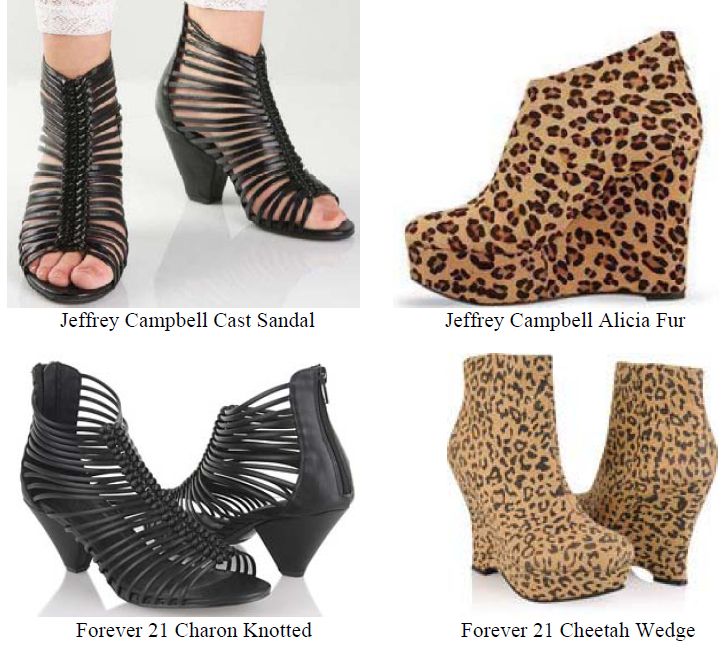
Courtesy of 'Couturebycapo Fashion'
Working for
a retail company that designs their own products, I know how frustrating it can
be when other companies copy your designs with only very slight variations. I
believe there will always be a debate over piracy, file-sharing, copying and
remix culture as technology is changing and evolving the way we perceive these
concepts. In order to keep up with these technological changes we must weigh up
the costs and benefits and most importantly always develop policies, as I
believe originality should be treasured.

Courtesy of 'Runway Gif - Tumbler'
References:
Felice, K
(2011) ‘Fashioning a solution for design piracy: considering intellectual
property law in the global context of fast fashion’, Syracuse Journal of
International Law & Commerce. Vol. 39, pp. 219-247.
Martin, B,
Moore, C and Salter, C. 2010, ‘Sharing music files: tactics of a challenge to
the industry’, First Monday, vol. 15, no. 12, [available:
http://firstmonday.org/htbin/cgiwrap/bin/ojs/index.php/fm/article/view/2986/2680].

Thanks Karni for the post.
ReplyDeleteI like the new perspective of viewing piracy. Normally, we focus on the illegal file-sharing on the Internet. We always miss out the piracy that happens in our everyday life. At least, I never relate the piracy to fashion industry. The new angle really amazed me.
Actually, I agree that originality should always be treasured. However, as the same for the other online piracy, it is very hard to define and find out who should be responsible for the infringement of copyright. Especially in the fashion industry, every piece of fashion items could be very similar. High-heels with different styles could mean the same to an outsider. Only little details could make the clothes a complete different one. Designers just cannot accuse the other designers and producers for the fashion piracy, due to some new decorations at the front of the clothes. The producers of those knockoffs can also argue that the products are the brand-new ones, but may be inspired by your products. Yet, this really hurts a fashion designer. Every design is designed and produced with much effort. The designers’ inspiration is priceless, so do those of all the creators, like composers and film directors. The fashion piracy certainly echoes the infringement of copyright in other different aspects.
I do believe it is hard to prevent copyright infringement from happening, especially in the fashion industry. As the violation of copyright on the Internet can be minimized by different means, like legislation, I think the piracy in the clothes-making industry can also be avoided. And I believe that only the fashion workers would know more about the actual situation. They could cooperate with the authority and try their best to protect their own industry.
Good Job.
At the start of there I feel you were speaking more as if you were writing an essay or a formal response as opposed to a weekly blog post. But as you went on and spoke about how frustrating it is, working at an original retail company, see how other retailers produce knock-off products of lesser quality and for a fraction of the price, you sounded extremely enthusiastic and I think that that passionate voice would’ve been a great voice to project. You referenced the reading well and did a good job at informing readers. I especially love the runway.gif, very entertaining when you think it’s a photograph!
ReplyDelete